
● Systematic Review Guide
What Tools Do You Need for a Systematic Review?
A step-by-step guide to conducting evidence-based medical research with the AliMed Systematic Review Tools Ecosystem.
Please note: A Systematic Review is more than just a literature summary; it is a rigorous, transparent, and reproducible research methodology. By synthesizing all available empirical evidence, it minimizes bias and provides a reliable foundation for clinical guidelines, policy-making, and future research. Whether you are mapping the evidence for a thesis, identifying research gaps, or supporting clinical decisions, a systematic approach ensures your conclusions are robust and defensible.
The AliMed Systematic Review Ecosystem Mind Map
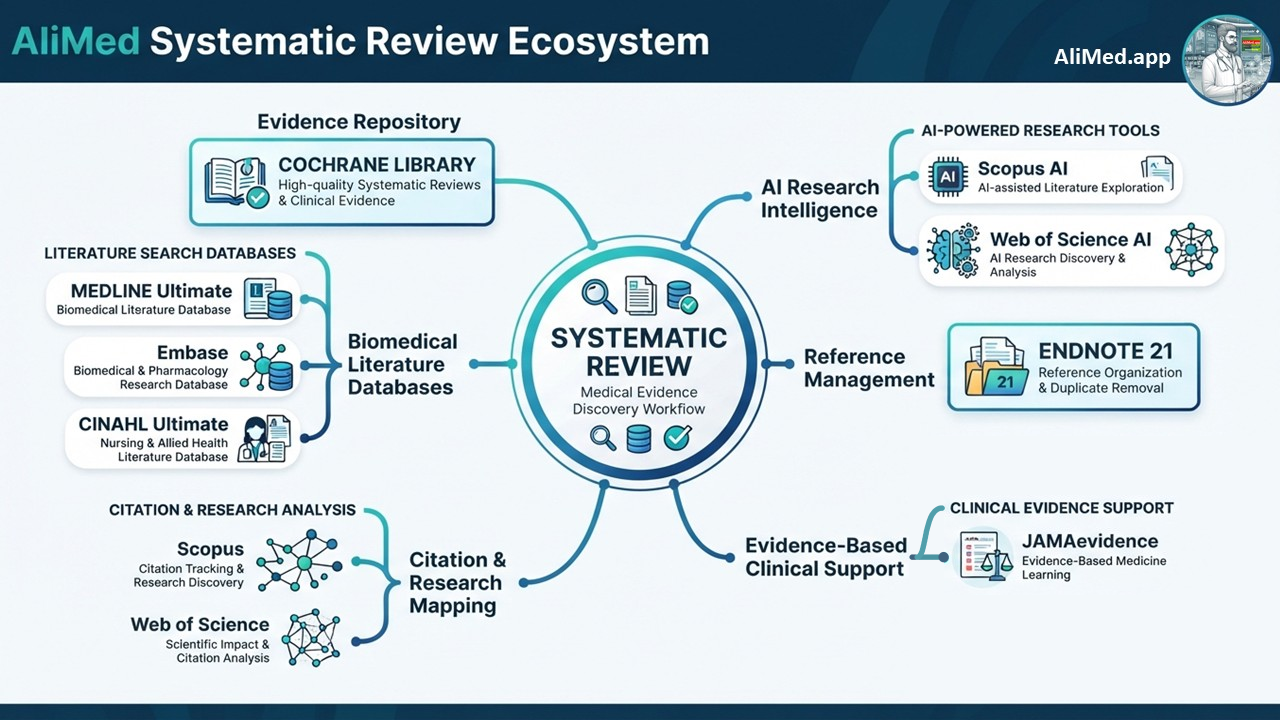

A high-quality Systematic Review requires searching multiple databases to avoid missing key studies. Restricting your search to a single source can lead to biased or incomplete results.
AliMed organizes the 12 essential tools you need across 6 core pillars, ensuring every step of your research is supported:
- 📚 Evidence Repository → Cochrane Library
- 🗄️ Biomedical Literature Databases → MEDLINE Ultimate, Embase, CINAHL Ultimate
- 🔗 Citation & Research Mapping → Scopus, Web of Science
- 🤖 AI Research Intelligence → Scopus AI, Web of Science AI
- 📖 Reference Management → EndNote
- ⚕️ Evidence-Based Clinical Support → JAMAevidence
STEP 01
Formulate Question
STEP 02
Search Evidence
STEP 03
Screen & Select
STEP 04
Extract & Assess
STEP 05
Synthesize & Report
Explore the detailed 8-step workflow below ↓
Steps to Conduct a Systematic Review
Based on authoritative sources including the Cochrane Handbook, PRISMA 2020, and the Campbell Collaboration.
01
Formulating the Research Question
This is the first and most critical step. The question must be specific and focused, and it provides the framework that guides all subsequent steps. The most common framework for clinical questions is PICO (Population, Intervention, Comparison, Outcome). For example: “In elderly patients, does handwashing of the patient compared to no handwashing affect the rate of nosocomial infections?”
Content note: A question that is too narrow may lack sufficient literature; one that is too broad may make completing the review difficult.
02
Registering the Protocol
A credible Systematic Review must have a protocol (project plan) that has been approved and published in advance. The Cochrane Handbook describes the protocol as part of the “planning the review” process. Registering the protocol in PROSPERO is an international standard that ensures methodological transparency and prevents bias.
03
Comprehensive Literature Search
This is a critical component that ensures comprehensive identification of relevant studies. The search must include both published and unpublished reports. To design a search strategy, you should know Emtree (Embase’s controlled vocabulary) and MeSH (for MEDLINE). Use Boolean operators (OR for grouping similar terms, AND for linking groups) and proximity operators (NEAR/NEXT).
Content note: Searching multiple databases is essential because restricting the search to a single source leads to missing important studies and bias in results.
04
Screening and Selecting Studies
After the search, all retrieved records must be collected for screening and selection. Using a reference management tool such as EndNote is strongly recommended because it facilitates organization and helps identify and remove duplicates. At least two reviewers must independently decide on issues such as study inclusion and coding.
05
Data Extraction
This step involves systematic collection of relevant information from each included study. A standard data extraction form is used that records a wide range of study-level and outcome-level variables. This ensures consistency and reduces errors during the synthesis phase.
06
Assessing Methodological Quality and Risk of Bias
This is an essential component of conducting a high-quality Systematic Review. The goal is critical appraisal of the design, conduct, and reporting of each study. The Cochrane Handbook version 6 describes the RoB 2 tool (for randomized trials) and ROBINS-I (for non-randomized studies). For observational studies, the Newcastle-Ottawa Scale is also common.
07
Data Synthesis
Evidence synthesis involves integrating findings from multiple studies through qualitative or quantitative methods — or both — depending on the nature of the data. If data are homogeneous, meta-analysis (quantitative analysis) is performed using software such as R and RevMan. The Cochrane Handbook dedicates Chapter 10 to meta-analysis and Chapter 11 to network meta-analysis.
08
Reporting Results
Reporting must comply with established guidelines, particularly PRISMA. PRISMA 2020 is a 27-item checklist that explains in detail the reporting recommendations for each item.
Content note: PRISMA is a reporting guideline, not a methodological guide. Many people confuse the two.
Common Questions About Systematic Reviews
It is a review that uses explicit, systematic methods to collate and synthesize findings of studies that address a clearly formulated question. Its purpose is to provide a reliable and exhaustive summary of the existing literature to inform clinical practice, policy, or future research.
A narrative review often provides a summary of a small selection of studies and may be biased because it is not comprehensive. A Systematic Review, on the other hand, follows a pre-defined, rigorous protocol to identify, evaluate, and synthesize all relevant evidence, minimizing bias and increasing transparency.
To minimize bias and ensure a comprehensive search, you should search multiple bibliographic databases. Searching only a few can result in missing relevant studies that could change the conclusion of your review. Recommended: MEDLINE, Embase, and Cochrane Library.
PICO stands for Patient/Population, Intervention, Comparison, and Outcome. It is a widely used framework for formulating a clear, focused research question and defining the criteria for including studies in your review.
Yes. Registering your protocol in a database like PROSPERO is highly recommended. It promotes transparency, reduces reporting bias, and helps prevent unintended duplication of research.
PRISMA (Preferred Reporting Items for Systematic Reviews and Meta-Analyses) is a reporting guideline. It provides a checklist of items to include when writing your review to ensure transparency and completeness. It is not a methodological guide for conducting the review itself.
EndNote is a reference management tool that is crucial for deduplicating records from different databases and organizing your references throughout the screening and writing process. View EndNote 21 →
Tools like Scopus AI and Web of Science AI can assist with faster literature exploration, summarizing findings, and discovering related research, helping to streamline the initial screening and discovery phases.
AliMed provides a complete ecosystem: Use Cochrane for evidence repositories; MEDLINE, Embase, and CINAHL for literature search; Scopus and WoS for citation mapping; Scopus AI and WoS AI for AI assistance; EndNote for reference management; and JAMAevidence, DynaMedEX, and BMJ Best Practice for clinical application.
Choose the Right Tools for Your Research
Selecting the right databases and reference management tools is critical for a high-quality systematic review. This table compares the key features, search capabilities, and unique strengths of the AliMed ecosystem tools to help you make an informed decision.
| Tool | Primary Role in SR Workflow | Coverage Type | Controlled Vocabulary / Search Method | Citation & Discovery Capabilities | Main Research Output | Key Strength |
|---|---|---|---|---|---|---|
| Cochrane Library | Identify existing systematic reviews and clinical trials | Evidence syntheses; CENTRAL trial records; other evidence resources | MeSH in relevant resources; structured database searching | Links between reviews, trials, and cited research vary by resource | Systematic reviews, trial records, evidence syntheses | Provides access to trusted systematic reviews and a major collection of controlled-trial records. |
| MEDLINE Ultimate | Core biomedical literature searching | Biomedical and life-sciences journal literature | MeSH; EBSCOhost advanced search, field searching, Boolean operators | Reference-level discovery; citation analysis is not its primary strength | Bibliographic records and abstracts, with full text for included licensed content | Supports structured biomedical searches using the established MeSH indexing system. |
| Embase | Comprehensive biomedical and pharmaceutical searching | Biomedical journals, conference abstracts, drug and medical-device literature | Emtree; extensive synonyms, exploded terms, proximity operators | Reference discovery, citation links where available, and export for screening | Bibliographic records, abstracts, conference records | Adds substantial pharmaceutical, conference, and European biomedical coverage beyond MEDLINE. |
| CINAHL Ultimate | Search nursing and allied health literature | Nursing, rehabilitation, allied health, and related clinical disciplines | CINAHL Headings; Boolean, field, and proximity searching | Reference discovery; limited emphasis on citation-network analysis | Bibliographic records, abstracts, and licensed full text | Provides specialized coverage of nursing and allied health research that broad biomedical databases may underrepresent. |
| Scopus | Supplementary searching and citation chasing | Multidisciplinary abstracts, journals, conference proceedings, and citation records | Primarily keywords, fields, Boolean operators, and proximity operators; no native MeSH/Emtree equivalent | Strong cited-by searching, author profiles, citation networks, and related-document discovery | Bibliographic and citation records; research analytics | Combines broad multidisciplinary discovery with forward citation tracking and research analytics. |
| Web of Science | Supplementary searching and citation chasing | Curated multidisciplinary scholarly literature, depending on subscribed indexes | Keywords, field searching, Boolean and proximity operators; no universal native MeSH/Emtree equivalent | Strong cited-reference searching, citation networks, and related-record discovery | Bibliographic and citation records; citation analysis | Enables structured citation chaining through its curated citation indexes and cited-reference data. |
| EndNote 21 | Reference management and deduplication | Records imported from external databases and other sources | No native literature index or controlled vocabulary; supports reference organization and search within imported records | Organizes references and links; not an independent citation-discovery database | Reference library, bibliographies, citations, and manuscript references | Centralizes imported references and supports deduplication and citation formatting throughout the review. |
| Scopus AI | Early-stage exploration and research-question development | AI-assisted discovery grounded in Scopus-indexed literature | Natural-language queries and AI-assisted topic exploration | Surfaces cited sources, foundational documents, concept maps, and emerging themes | Topic summaries, research connections, and exploratory insights | Helps researchers explore unfamiliar topics and identify potentially relevant research directions quickly. |
| Web of Science AI | Research exploration and literature-review planning | AI-assisted discovery grounded in Web of Science Core Collection data and supported content | Natural-language queries, guided workflows, and AI-assisted discovery | Supports literature exploration, topic mapping, citation connections, and research-trend analysis | Research summaries, structured exploration, and literature-review insights | Connects AI-assisted exploration with curated scholarly records and citation-network context. |
| JAMAevidence | Learn critical appraisal and evidence-based medicine | Evidence-based medicine textbooks, appraisal frameworks, and clinical evidence resources | No general-purpose bibliographic thesaurus; uses structured EBM concepts and clinical questions | Not designed for comprehensive bibliographic searching or citation-network analysis | Appraisal guidance, clinical evidence interpretation, and EBM learning resources | Helps reviewers understand study validity, diagnostic evidence, and the interpretation of clinical research. |
Explore the Complete Systematic Review Ecosystem with AliMed
Discover AliMed’s curated selection of evidence databases, citation mapping tools, and reference management resources.
A high-quality systematic review relies on rigorous methodology. The AliMed Ecosystem provides the foundational databases and management tools necessary to conduct transparent, evidence-based research.